SC — INSIGHTN°49
SoundInsightN°50
01
Strong earnings growth signals robust demand and makes inflation harder to contain.
02
Under Kevin Warsh, the Federal Reserve is placing a clear priority on restoring price stability.
03
Persistently higher rates risk turning US debt-servicing costs into a structural constraint.
Bonds
Overview
Interest Rates
Credit Spreads
UnattractiveAttractive
Equities
Overview
Equity Risk Premium
Leading Indicators
Risk Index
UnattractiveAttractive
Posted 9/22/2026 by Christian Luchsinger
The Price of Growth
Strong earnings growth signals resilient demand, while rising oil prices intensify supply-side inflation. Together, these forces are pushing central banks back towards a more restrictive stance.
At the start of the year, our Outlook 2026 made a clear point: The tailwind from monetary policy would fade. Rate cuts would become less frequent and more selective, while growth, fiscal policy and geopolitical developments would play a larger role.
The picture has since changed more sharply than expected. The question is no longer whether interest rates will fall, but how far they may have to rise again. The European Central Bank and the Bank of Japan raised policy rates in June. Further increases followed in September, this time including the US Federal Reserve. Additional moves remain possible.
What stands out is how calmly equity markets have responded so far. Higher interest rates are usually a headwind: they raise financing costs, reduce the present value of future earnings and make safer assets more attractive. This time, however, tighter monetary policy is colliding with an exceptionally strong earnings cycle.
That is the central tension. Economic strength is supporting equities, but it is also sustaining inflationary pressure and forcing central banks to maintain a more restrictive stance.
Earnings Cushion the Rise in Rates
The second-quarter reporting season was once again far stronger than expected. Aggregate earnings for the S&P 500 rose 50% year on year. Even after adjusting for exceptional valuation gains at Alphabet and Amazon, growth was still 32%, compared with a consensus forecast of just 22%.
The strength was not confined to a handful of companies. More than 80% of constituents increased earnings from the previous year—a breadth of growth rarely seen since 2003. Corporate guidance was also unusually positive, particularly in the technology and industrial sectors.
Bank of America consequently raised its full-year S&P 500 earnings estimate to US$365, implying growth of 33% year on year. The pace is expected to moderate in 2027. Even so, projected growth of 12% from this much higher base leaves the outlook constructive.
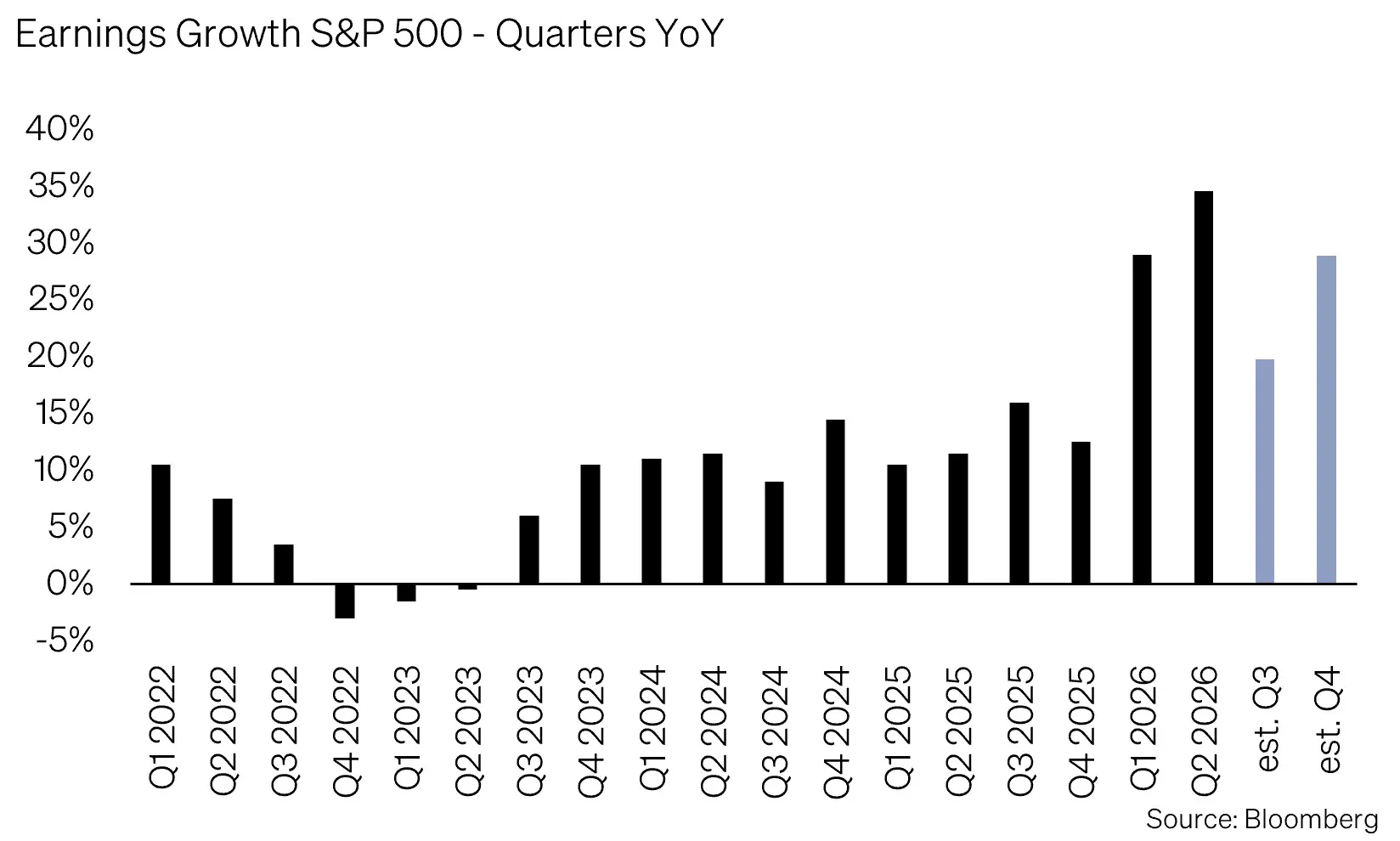
This helps explain the resilience of equity markets. Investors are not ignoring higher interest rates. Rather, earnings growth has so far been strong enough to offset the negative valuation effect of higher discount rates.
Yet good news increasingly comes at a price.
Two Sources of Inflationary Pressure
Strong corporate earnings do not directly cause inflation. They do, however, show that demand, investment and pricing power are stronger than expected. This is particularly evident in the expansion of artificial-intelligence infrastructure.
Data centres, semiconductors, power grids, cooling systems and electrical equipment require enormous amounts of capital, energy and industrial inputs. This investment is already supporting growth, while the hoped-for productivity gains will take longer to emerge. In the meantime, rapidly rising demand is meeting limited capacity, with consequences for both prices and financing costs.
Alongside this demand-side impulse, oil is delivering a classic supply shock. Brent crude has climbed back above US$100 per barrel. As recently as June, Bloomberg Economics assumed an average of US$82 for the third quarter.
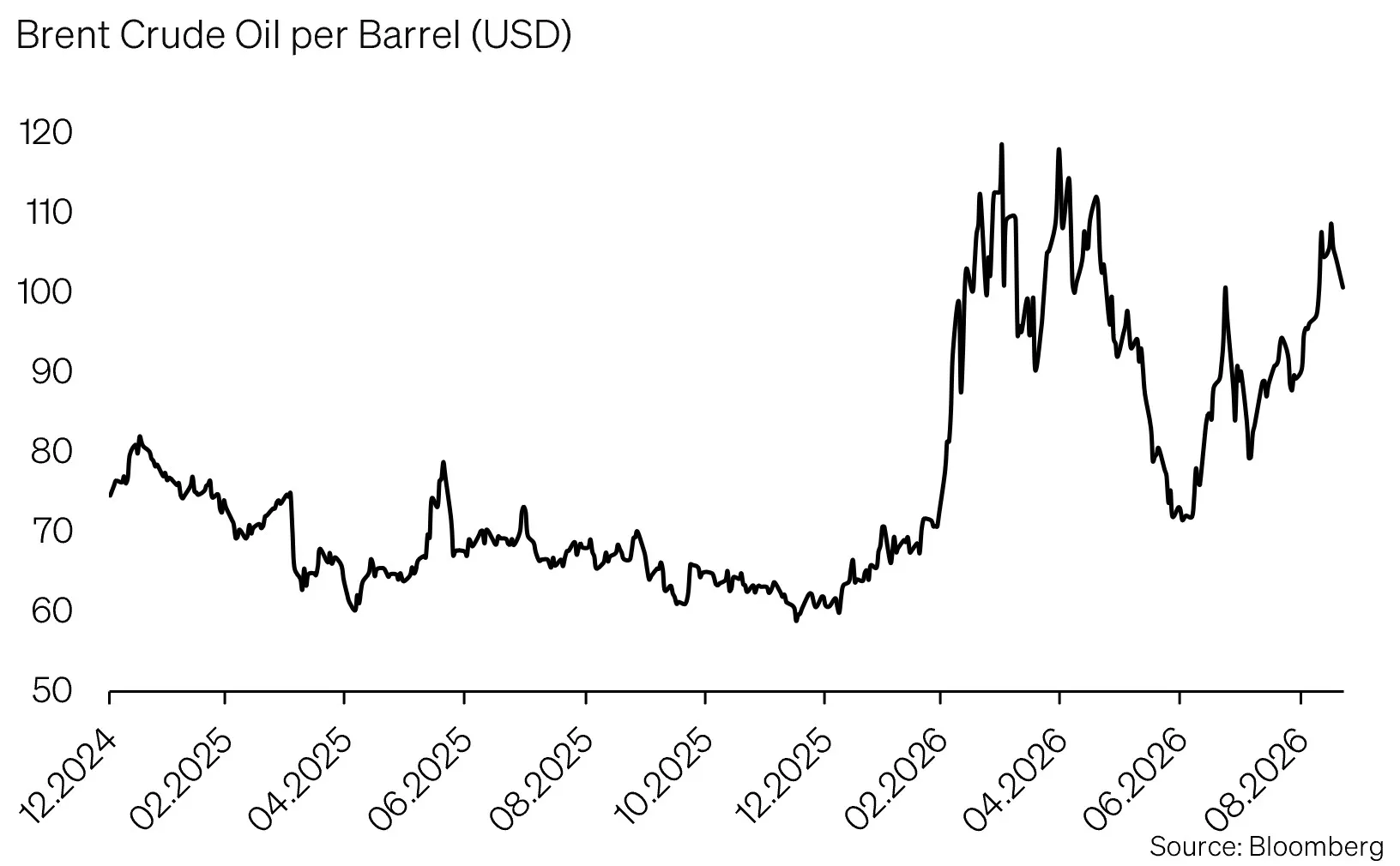
The latest escalation involving Saudi Arabia’s East-West Pipeline has once again exposed the vulnerability of global energy supply. The pipeline had become the most important route bypassing the Strait of Hormuz and carried around 3.9 million barrels per day in August—roughly 28% of the region’s oil exports. Its temporary shutdown is forcing Saudi Arabia to move more oil through the Strait of Hormuz, a route that remains exposed to the risk of Iranian attacks.
Higher oil prices reach far beyond the petrol pump. They increase the cost of transport, shipping, plastics, fertilisers and numerous industrial inputs. Combined with rising prices for semiconductors and electrical equipment, the result is a broader global inflationary impulse.
Central banks are therefore confronting two distinct sources of inflation at the same time: strong demand and investment on the one hand, and geopolitically driven supply constraints on the other.
A New Regime at the Fed
The Federal Reserve has responded with an unambiguous message. In September, the Federal Open Market Committee unanimously raised its policy rate by 25 basis points to a target range of 3.75–4.00%. Fed Chair Kevin Warsh described the move as a sign of the central bank’s determination to restore price stability.
The communication points to a possible regime shift. Warsh appears to place greater weight than his predecessors on current energy prices, financial conditions and asset-price developments. At the same time, the threshold at which labour-market weakness would trigger a monetary-policy response seems to have risen.
This is also a response to the experience of recent years. Supply shocks were long treated as transitory, allowing second-round effects to take hold in wages, rents and services. The new Fed leadership is clearly intent on avoiding a repeat.
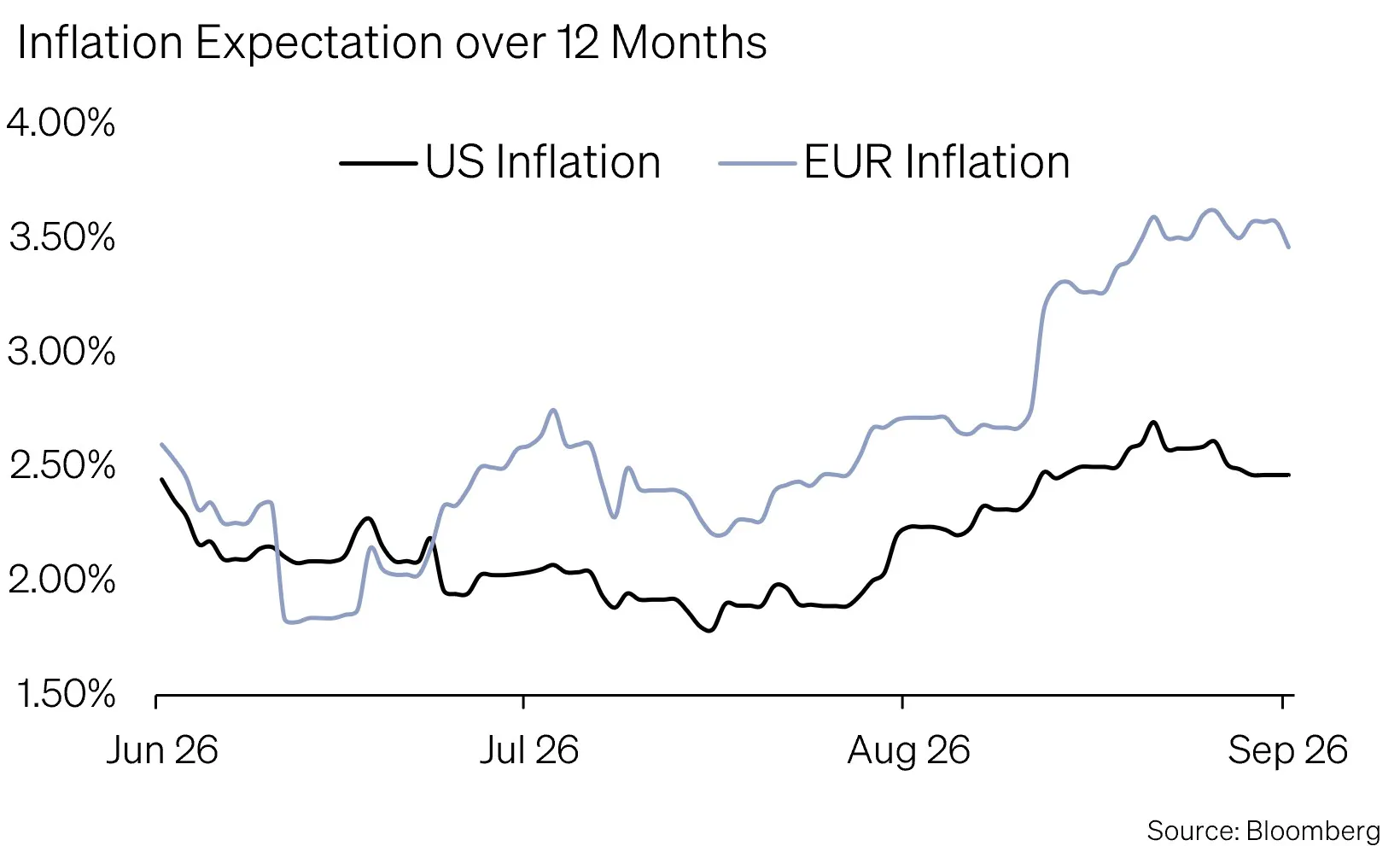
Price pressures also remain broad-based. Around 51% of the components in the US personal consumption expenditures basket are currently rising at an annual rate above 3%. Inflation is therefore not confined to a small number of volatile categories.
Following September’s increase, UBS expects another rate rise in December. The October meeting falls only days before the US midterm elections and is therefore likely to be particularly sensitive. The precise timing matters less, however, than the change in the Fed’s reaction function: as long as inflation, growth and financial markets remain strong, monetary policy is likely to stay restrictive. Markets have already priced in part of this shift.
Monetary Policy Cannot Produce Oil
Higher interest rates can restrain demand, curb credit growth and prevent inflation expectations from becoming entrenched. They cannot repair a damaged pipeline or move additional tankers through the Strait of Hormuz.
This is the dilemma confronting central banks. The more forcefully they respond to an oil-price shock caused by supply constraints, the greater the strain on parts of the economy that have little to do with the original price increase. Yet ignoring the shock altogether would also be risky. If energy prices remain high for an extended period, the likelihood of second-round effects rises, while household purchasing power comes under further pressure.
Central banks must therefore demonstrate resolve even though a substantial part of the solution lies beyond their control. Their strategy can succeed only if inflationary pressure eases relatively quickly. Otherwise, policy would have to tighten further, creating a new set of risks.
The Clock Is Ticking
Since the Congressional Budget Office published its latest fiscal projections, the US yield curve has shifted around 80 basis points higher. With a moderate debt burden, that would be manageable. With federal debt now exceeding US$40 trillion, however, the additional cost accumulates rapidly.
UBS estimates that a sustained 80-basis-point increase in interest rates could add around US$2.5 trillion to cumulative US deficits through 2036. Federal net interest outlays already amount to roughly 3.3% of gross domestic product and could rise to 5.6% by 2036.
The US government already spends more than US$1 trillion a year on servicing its debt. Interest payments absorb around 15% of total federal spending and now exceed defence expenditure.
The problem is not simply the amount of debt, but its price. If financing costs remain high, a self-reinforcing cycle can emerge: higher interest expenditure widens deficits, wider deficits increase financing needs, and a growing supply of government bonds in turn demands higher yields.
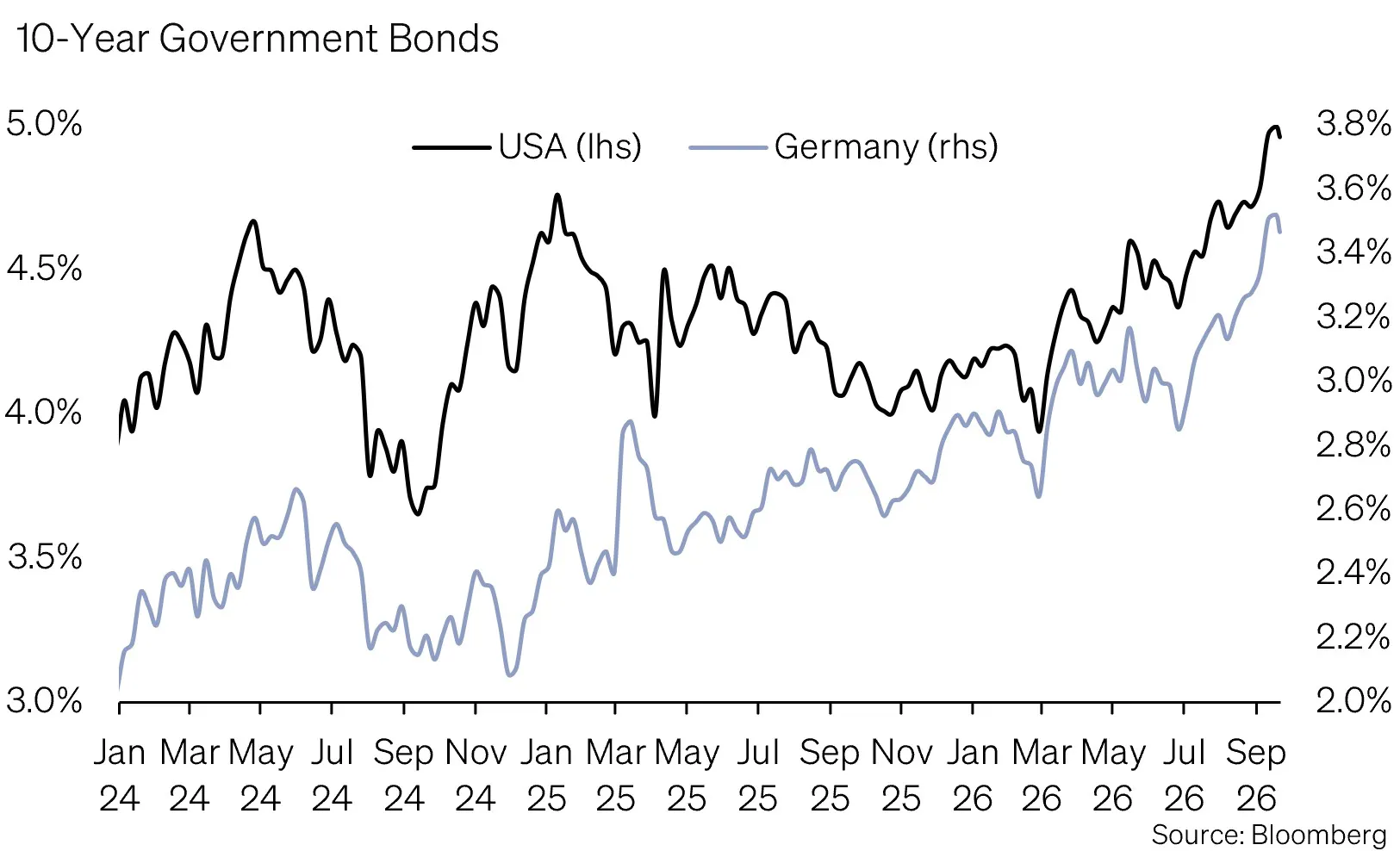
This is where the term premium becomes important again. Investors require greater compensation to hold long-dated government bonds when inflation, supply and fiscal risks increase. Long-term yields may therefore remain elevated even if the central bank later cuts its policy rate.
The fight against inflation must therefore do more than succeed. It must succeed relatively quickly.
Politics Returns to the Market
With the US midterm elections approaching in November, the political dimension is moving back to centre stage. High petrol prices are immediately visible to households and therefore electorally significant. At the same time, decisions on energy, foreign and trade policy are having an increasingly direct impact on inflation.
A de-escalation around the Strait of Hormuz would do more than calm the oil market. It could lower inflation expectations, reduce pressure on central banks and stabilise long-term bond yields. Renewed escalation would have the opposite effect.
This creates a tight feedback loop between politics and markets. Geopolitical headlines become inflation signals; inflation signals become interest-rate expectations; and those expectations, in turn, become a political burden.
The room for manoeuvre is narrowing. The US administration needs lower energy prices without triggering economic weakness. The Fed needs lower inflation without tightening financial conditions more than necessary. Markets are counting on both objectives being achieved.
SoundCapital Positioning
The strength of the earnings cycle argues against a broad retreat from equities. As long as revenues, margins and corporate guidance remain positive, markets retain solid fundamental support.
The starting point has nevertheless become more demanding. Investor positioning remains optimistic, risk premia are low, and the S&P 500 has not suffered a pullback of more than 5% in almost six months. At the same time, a growing share of earnings is concentrated in a small number of companies: five groups now account for around 27% of the index’s expected profits, while semiconductors are projected to deliver more than 60% of total earnings growth in 2027.
This concentration increases the market’s sensitivity to disappointment. That matters particularly if earnings growth loses momentum in 2027, as expected. Historically, equity returns have been considerably more moderate when earnings continued to grow above trend but the rate of growth slowed.
We therefore remain fundamentally invested, but have extended our existing equity hedge through year-end. This is not a forecast of an imminent market correction. It reflects an asymmetric balance of risks: a great deal of optimism is already priced in, while geopolitical tensions, rising interest rates around the world and the political calendar increase the potential for negative surprises.
Our focus remains on companies with strong balance sheets, reliable cash flows and durable pricing power. They are better placed to absorb higher financing costs. Gold retains its strategic role as a hedge against geopolitical risk, inflation surprises and a potential loss of confidence in fiscal policy.
At the start of the year, we expected the monetary tailwind to diminish. It has since turned into a headwind. For now, an exceptionally strong earnings cycle is offsetting the pressure. But the longer interest rates remain high, the more visible the side effects will become.
Growth is too strong for rate cuts, inflation too broad for complacency and debt too high for interest rates to keep rising indefinitely. Good news is still good news—but it now comes at a higher price.
Appendix & Disclaimer
SoundInsights is the central tool for our investment allocation. We use it to systematically and consistently assess the aspects that are relevant to the development of the financial markets. As a result, our clients can rely on a rational and anti-cyclical implementation of our investment decisions.
- Focusing on the essentials
Interest rate level, risk premium, valuation, economic development, investor sentiment and positioning. These are the decisive factors for success on the financial markets, especially in turbulent times when the temptation to react irrationally to the headlines is particularly strong. - Comparability over time and place
The factors mentioned above are equally relevant for all markets and at all times. This is the result of a strict «backtesting» process that continues into the future. - Cumulating our investment experience
Our strength lies in the many years of experience of our partners and principals. It is precisely this experience that we summarize and make it applicable with SoundInsights. - Transparency
Thanks to our monthly publication, our clients always know where we stand in the investment cycle and how we expect the financial markets to develop.
This document has been prepared by Sound Capital Ltd ("SoundCapital") for information and marketing purposes and is intended for the recipient. The information contained herein has been prepared with due care and is based on sources considered reliable by SoundCapital. However, no representation or warranty is made as to the accuracy, completeness or reliability of such information. To the extent permitted by applicable law, SoundCapital accepts no liability for any loss or damage arising from the use of this information. This document does not constitute an offer or solicitation to buy or sell any financial instrument or to enter into any transaction, nor does it constitute investment, legal, tax or other advice or a personal recommendation. It should not be relied upon as the sole basis for any investment decision. Recipients should make their own assessment of the information, taking into account their individual circumstances, investment objectives, financial situation and needs, as well as the relevant legal, regulatory and tax implications, and seek independent professional advice where appropriate. Investments involve risks and may result in the partial or total loss of the invested capital. The value of investments and any income derived from them may fluctuate and are not guaranteed. Past performance is not a reliable indicator of future results. Forecasts, projections, estimates, target returns and other forward-looking statements are based on assumptions that may change and likewise do not provide a reliable basis for assessing future performance. Actual results may differ materially from the expectations expressed or implied by such forward-looking information. Unless otherwise stated, the information contained in this document is provided as of the date indicated. It may be changed at any time without prior notice. SoundCapital is under no obligation to update or revise such information. This document is not intended for any person or entity in any jurisdiction where its distribution, publication or use would be contrary to applicable laws or regulations or would subject SoundCapital to any registration or other requirement. This document may not be reproduced, distributed or transmitted, in whole or in part, without the prior written consent of SoundCapital.
© 2026 Sound Capital Ltd. All rights reserved.
Datasource: Bloomberg, BofA ML Research, UBS