SC — INSIGHTN°50
SoundInsightN°48
01
A Historic Earnings Cycle: Four Quarters of Growth Above 20%
02
Valuations and Concentration Remain High
03
Investment Boom Is Spreading to Industrials, Utilities and Materials
Bonds
Overview
Interest Rates
Credit Spreads
UnattractiveAttractive
Equities
Overview
Equity Risk Premium
Leading Indicators
Risk Index
UnattractiveAttractive
Posted 7/27/2026 by Christian Luchsinger
An Exceptional Earnings Cycle
Four times a year, America's largest corporations open their books and reveal how much they have earned. For investors, "earnings season" is the most important reality check: it separates what companies have promised from what they actually deliver. And in 2026, they are delivering exceptionally well. For the S&P 500—the index of the 500 largest US companies—one of the strongest earnings years on record is taking shape.
The opening act: 13 percent expected, 29 percent delivered
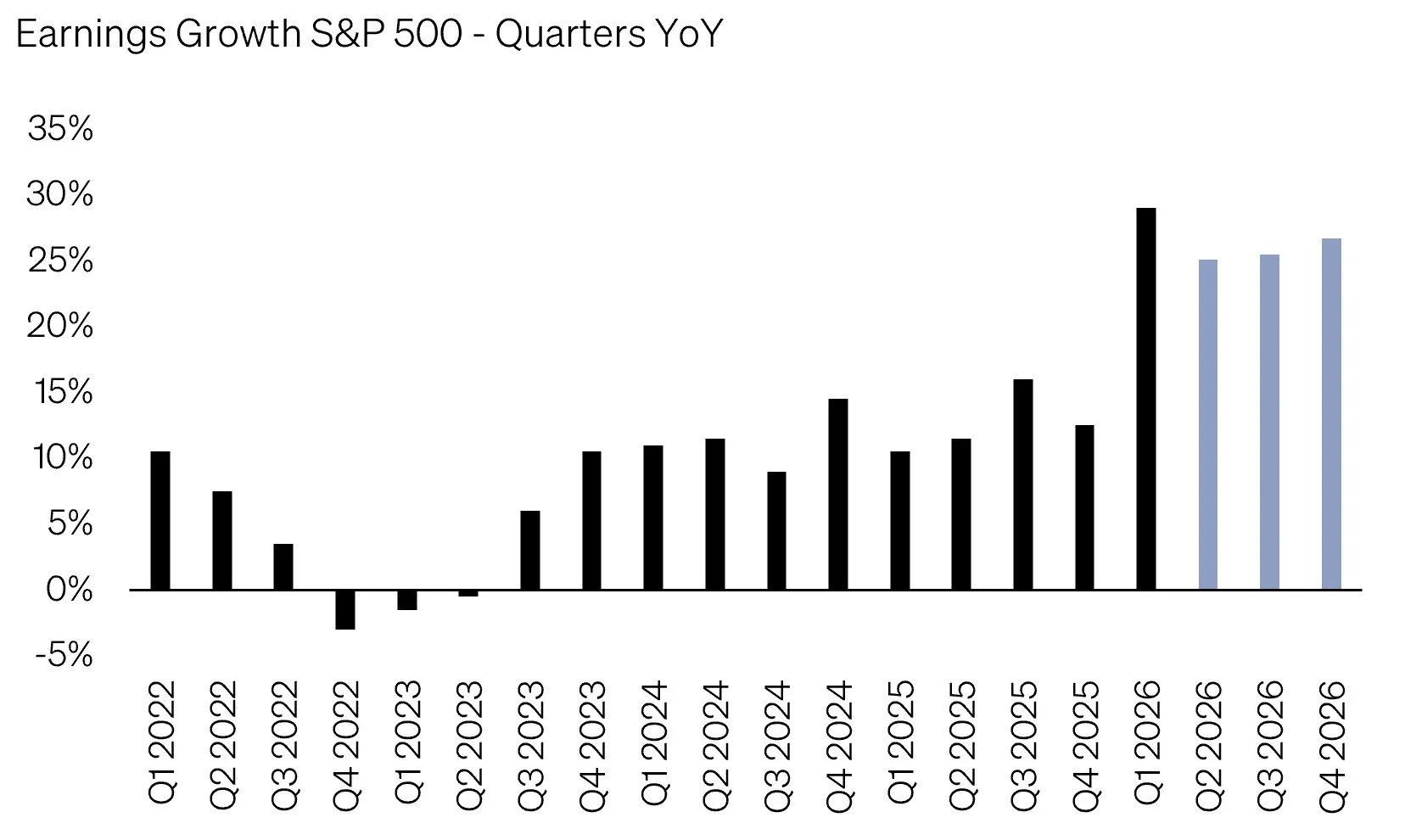
Before each earnings season begins, analysts estimate how sharply profits are likely to rise. For the first quarter of 2026, that expectation stood at around 13 percent year-on-year. The final figure came in at 29 percent—more than double. It was the strongest reading since the end of 2021, when many companies were rebounding from the shock of the pandemic.
What matters is where this gain came from. Companies didn't just sell more (revenue up 11 percent); they also earned more on every dollar sold—profit margins rose sharply. In other words, they are growing more profitably, which can be seen as a sign of quality.
The second quarter confirms the picture
The current second-quarter season fits seamlessly into this pattern. So far, earnings are tracking toward a gain of around 28 percent. As usual, roughly four out of five companies are beating expectations—but this time what counts is by how much. Revenue, too, is growing at a solid 12 percent, the fastest pace since 2022. That puts earnings growth above 20 percent for the second consecutive quarter—and in double digits for the seventh quarter in a row.
The real record: a full year above 20 percent—with no preceding crisis
Here is the part that makes this cycle historic. In 2026, all four quarters are on course to deliver earnings growth above 20 percent. The first quarter (29 percent) is in the books, the second (around 28 percent) is being realized now. For the third and fourth, analysts expect 27 and 25 percent respectively. Over the full year, that works out to roughly 25 percent—about twice the rate of a normal year.
Why is this so unusual? In the past, growth rates like these appeared almost exclusively after a slump: after the pandemic in 2021, after the financial crisis in 2010, around the dot-com years. In every one of those cases, earnings surged so strongly only because they had collapsed the year before—the recovery started from a low base. In the run-up to 2026, there was no such collapse. Earnings were already high and are still growing vigorously. A surge like this without a preceding crisis is the true rarity.
Another sign of this cycle's strength: analysts normally cut their forecasts while a quarter is under way—in 2026, they are raising them. That, too, is rare, and it underlines just how strongly the results are coming in.
What's new: it's no longer just the tech giants
Until now, the rule held that a handful of technology companies accounted for almost all of the earnings growth. That is changing—and for investors, it may be the single most important development. The technology sector continues to grow at an above-average pace, to be sure. But the entire rest of the market is now also expanding by double digits, the strongest showing since the end of 2021. Ten of eleven sectors are growing in earnings; all eleven are growing revenue.
Behind this lies a chain reaction, triggered in part by the construction of the vast data centers for artificial intelligence. It can be read in three stages:
Stage 1—the major cloud companies invest enormous sums in new data centers.
Stage 2—the semiconductor industry is the first to benefit: chip and hardware makers alone contribute more than ten percentage points to the index's total earnings growth in 2026.
Stage 3—the broader industrial economy follows: data centers need power, grids, cooling, machinery, and raw materials. In the second quarter, the materials sector is up around 30 percent, industrials a solid 11 percent, and utilities are benefiting from rising consumption.
One jump, however, falls outside this chain: the fact that the energy sector is posting over 100 percent earnings growth in the second quarter has nothing to do with the data-center build-out. It reflects the higher oil price, pushed up by tensions around the Strait of Hormuz—a geopolitical one-off, not part of the investment cycle.
That this investment surge is only now broadening out is clear from further figures: outside the cloud companies, corporate free cash flow has risen by more than 200 billion dollars, orders for machinery and equipment are climbing by around 10 percent, and nearly half of large US firms plan to increase their capital spending by double digits. For the fourth quarter, the many "other" companies are even expected to grow faster than the tech giants themselves for the first time.
What investors should keep in mind
First, a great deal still hangs on a few names. The average company in the index is growing only around 9 percent—the 25 percent at the index level comes largely from a handful of semiconductor heavyweights. Strip out the two biggest drivers and growth falls from around 25 percent to a still-solid 17 percent.
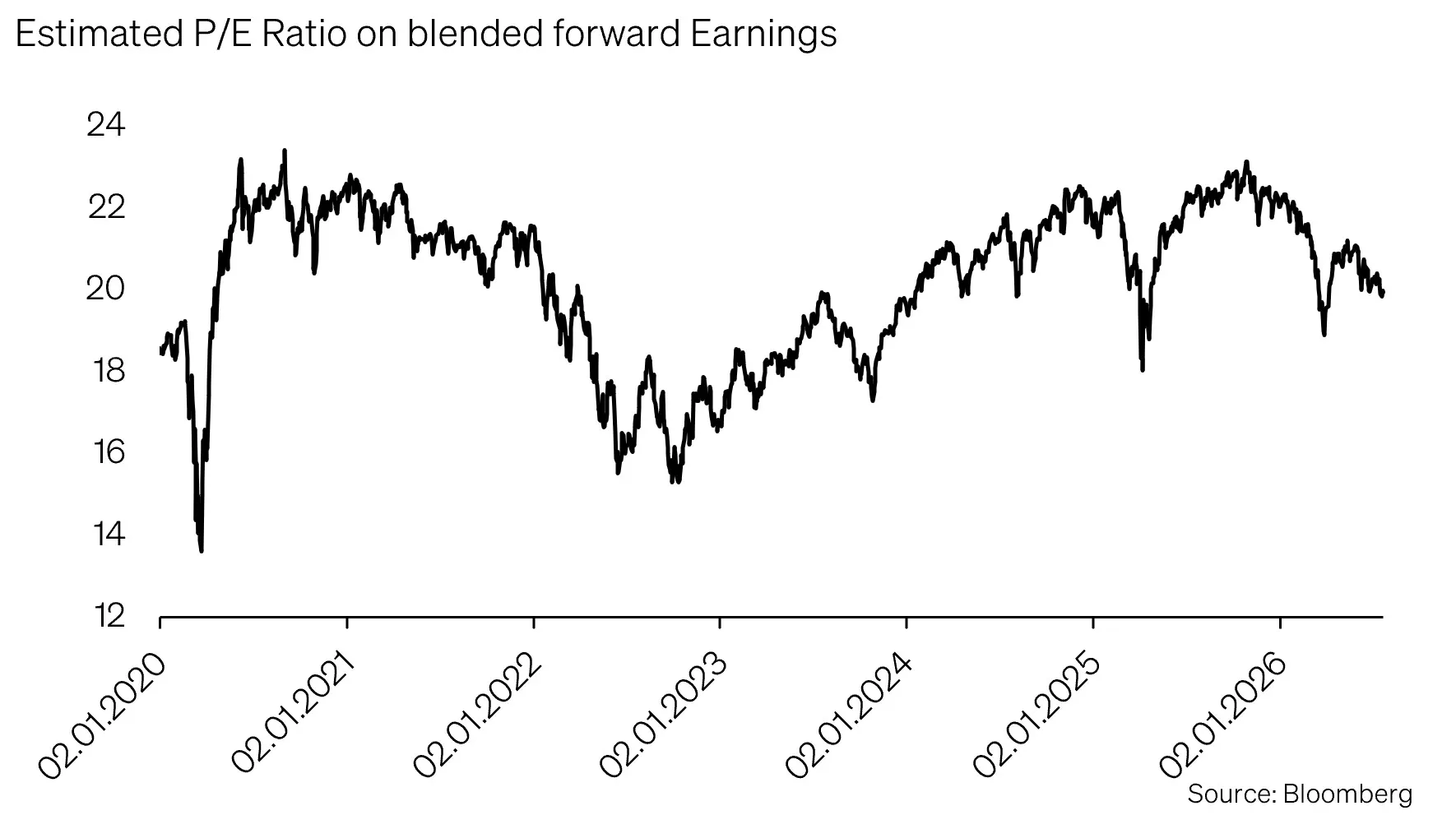
Second, US equities are not cheap. The price-to-earnings ratio—the price investors pay for a dollar of expected earnings—sits above its ten-year average. For context, it helps to look back at the dot-com bubble in 2000: back then, the technology sector was vastly more expensive than its business figures justified. Today the relationship is reversed—it is actual earnings that are carrying prices, not mere hope for the future.
Putting it in perspective
The 2026 earnings cycle is exceptional—above all because of its duration and its origin: four strong quarters in a row, for the first time without the base effect of a preceding crisis. The high valuations and the dependence on a few names are the flip side. The decisive question for the second half of the year is this: does the strength truly carry through—from the chip makers, across the industrial economy, and into the full breadth of the market? If it does, this upswing will rest on a considerably more stable foundation. What began as a US tech story then becomes the story of a new growth cycle for the global economy.
Positioning
What does all this mean for how portfolios should be oriented? The earnings cycle described above sets a constructive backdrop: robust growth that is increasingly broadening out, but accompanied by elevated valuations and distinctly optimistic investor sentiment. Our positioning accounts for both: participating in this upswing while remaining guarded against the possibility that the euphoria tips over.
Bonds
In fixed income, we are maintaining our overweight in high-quality corporate bonds—they form the solid foundation of the portfolio's fixed-income allocation. Their scope for additional return, however, is limited: credit spreads—the yield premium investors receive for a company's higher default risk relative to a safe government bond—have become very tight. This shows up even more clearly one rung lower, in high-yield bonds: they currently offer inadequate compensation for the greater risks they carry. We therefore deliberately forgo this asset class.
Equities
We remain constructive on equity markets. At the same time, investor euphoria has increased once again of late. To cushion potential setbacks, we are hedging part of the equity allocation with a put option. This reduces short-term downside risk without giving up participation in the uptrend. The investment and earnings cycle described above remains a solid support for markets, while high valuations, central-bank policy, and geopolitical risks continue to argue for a targeted risk buffer.
Regionally, we remain overweight emerging markets. Within this positioning, however, we are making one adjustment: we are reducing China to a neutral weighting, as its earnings growth is weak by international comparison—precisely the yardstick that currently defines the market.
Alternative investments
Gold remains a building block for us, one that often behaves differently from equities and bonds and thereby lends the portfolio stability. The gold price has recently suffered under rising rate expectations, but a floor appears to have been found. The price targets of some banks—Bank of America's USD 6,000, for instance—remain attractive. Above all, though, the persistent political and monetary-policy uncertainties support the long-term investment case.
Appendix & Disclaimer
SoundInsights is the central tool for our investment allocation. We use it to systematically and consistently assess the aspects that are relevant to the development of the financial markets. As a result, our clients can rely on a rational and anti-cyclical implementation of our investment decisions.
- Focusing on the essentials
Interest rate level, risk premium, valuation, economic development, investor sentiment and positioning. These are the decisive factors for success on the financial markets, especially in turbulent times when the temptation to react irrationally to the headlines is particularly strong. - Comparability over time and place
The factors mentioned above are equally relevant for all markets and at all times. This is the result of a strict «backtesting» process that continues into the future. - Cumulating our investment experience
Our strength lies in the many years of experience of our partners and principals. It is precisely this experience that we summarize and make it applicable with SoundInsights. - Transparency
Thanks to our monthly publication, our clients always know where we stand in the investment cycle and how we expect the financial markets to develop.
This document is an advertisement and is intended solely for information purposes and for the exclusive use by the recipient. This document was produced by SoundCapital (hereafter «SoundCapital») with the greatest of care and to the best of its knowledge and belief. However, SoundCapital does not warrant any guarantee with regard to its correctness and completeness and does not accept any liability for losses that might occur through the use of this information. This document does not constitute an offer or a recommendation for the purchase or sale of financial instruments or services and does not discharge the recipient from his own judgment. Particularly, it is recommended that the recipient, if needed by consulting professional guidance, assess the information in consideration of his personal situation with regard to legal, regulatory and tax consequences that might be invoked. Although information and data contained in this document originate form sources that are deemed to be reliable, no guarantee is offered regarding the accuracy or completeness. A past performance of an investment does not constitute any guarantee of its performance in the future. Performance forecasts do not serve as a reliable indicator of future results. This document is expressly not intended for persons who, due to their nationality or place of residence, are not permitted access to such information under local law. It may not be reproduced either in part or in full without the written permission of SoundCapital.
© 2025 SoundCapital. All rights reserved.
Datasource: Bloomberg, BofA ML Research
SC — INSIGHT
SoundInsights™
SC — INSIGHTN°49
SC — INSIGHTN°47

SC — WWO01
PMA
What we offer
Portfolio Management
Asset management with a vision for long-term investment success
SC — WWO02
INA
What we offer
Investment Advisory
Solid advice for better-informed investment decisions
SC — WWO03
WMS
What we offer
Wealth Management Services
Comprehensive wealth management services for your financial future