SC — INSIGHTN°51
SoundInsightN°52
01
Corporate earnings in the US and Europe rose by more than 30% in the third quarter. Yet equity markets have corrected sharply.
02
Valuations in the US and emerging markets are falling—not because earnings are collapsing, but because doubts are growing over whether they are sustainable.
03
We have closed our put hedges. AI and energy infrastructure—the biggest losers of recent days—are where opportunities are now likely to emerge.
Bonds
Interest Rate Levels
+1
Credit Spreads
+1
UnattractiveAttractive
Equities
Overview
Equity Risk Premium
Leading Indicators
Risk Index
UnattractiveAttractive
Posted 11/24/2026 by Christian Luchsinger
A reality check for AI euphoria
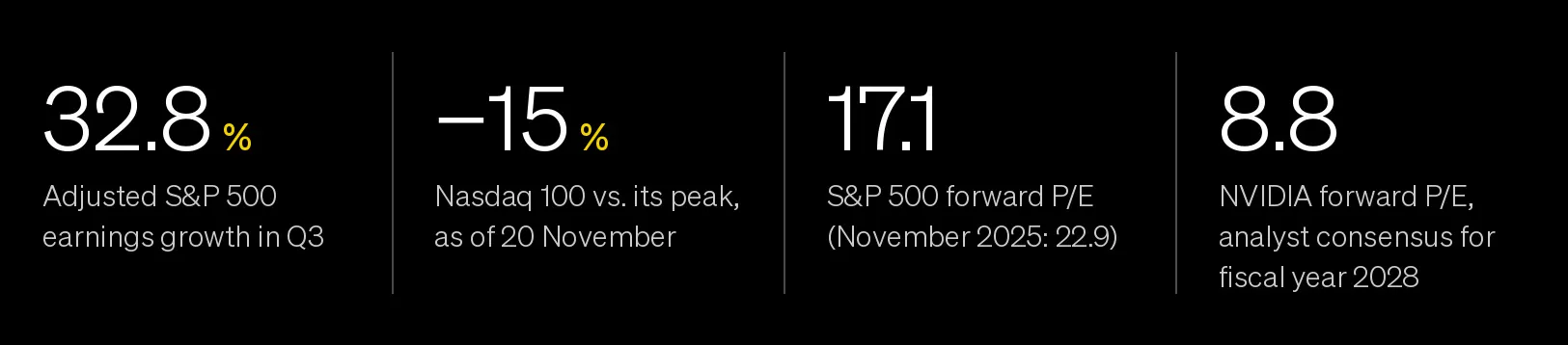
S&P 500 companies are likely to have grown their earnings by 32.8 percent in the third quarter, while in Europe, earnings reported so far are 35 percent higher than a year ago. Even so, the Nasdaq 100 has fallen around 15 percent from its peak—in the very week of the largest tech IPO in history.
Strong results alone are no longer enough. The market is less concerned about current earnings than about whether this exceptional growth can last—and it is paying less for it accordingly.
When good numbers are no longer enough
The reporting season delivered not only strong results but also confident outlooks. Over the past three months, analysts have raised their twelve-month forward earnings estimates for the S&P 500 by 7.3 percent and their estimates for 2027 by 4.5 percent. In the technology sector, the upward revision for 2027 was even larger, at 10.6 percent.

Little of this is reflected in share prices. Technology stocks in particular have lost ground, and even positive earnings surprises are now often met with falling prices. Several factors are weighing on the market: doubts about how the AI ecosystem is financed, with companies helping to fund their own largest customers; the departure of NVIDIA’s long-standing CEO Jensen Huang; and the outcome of the midterm elections, which we discussed in our last issue. The Democrats’ clear victory is likely to pave the way for stricter AI regulation and tighter rules on building data centres.
For the Nasdaq 100, this is the steepest decline since the US tariff announcements of April 2025, the so-called "Liberation Day". But the nervousness extends well beyond US technology stocks: as of 20 November, the S&P 500 was around 8 percent below its peak, the MSCI Emerging Markets Index around 19 percent and Japan’s Nikkei 225 around 22 percent.
The market is paying less for growth
When share prices fall while earnings estimates rise, valuations come down. This de-rating is affecting not just individual AI companies but entire markets. The forward P/E of the S&P 500 has fallen from 22.9 to 17.1 within a year. The move has been even more pronounced in emerging markets, where share prices fell even as earnings expectations rose sharply on the back of surging chip sales. Their forward P/E dropped accordingly from 13.8 to 7.9. Europe, by contrast, has become only slightly cheaper, and the defensive Swiss market is now valued somewhat higher than a year ago.

Strong earnings offer no protection against falling share prices. In 2022, too, valuations fell as interest rates rose, without corporate earnings collapsing immediately. Interest rates are playing a role today as well: as we described in our last issue, long-term bond yields have risen markedly—and with them the bar for equities.

Lower valuations are not automatically a buy signal, as they are only as robust as the earnings estimates on which they are based. But the signs are encouraging: companies issued very confident guidance this reporting season. If the estimates prove correct, equities are now as cheap as they have been in a long time. The S&P 500 is trading well below its post-2022 average of 19.8, and emerging markets are valued lower than at any other point over that period. NVIDIA is a particularly striking example: based on the analyst consensus for fiscal year 2028, which ends in January 2028, the company is valued at just 8.8 times expected earnings. It is forecast to generate revenue of around USD 630 billion—roughly 60 percent of Switzerland’s entire economic output. If the company meets these expectations, the stock is very attractively valued today.
AI: from market theme to economic driver
Despite all the nervousness, Anthropic’s IPO on 19 November showed just how high expectations for artificial intelligence remain. At USD 107.3 billion, including a concurrent private placement, it is the largest IPO in history. Demand outstripped supply several times over, and the shares closed their first day of trading 17 percent above the offer price. With a valuation of around USD 1.8 trillion, Anthropic immediately ranks among the ten largest listed companies in the world.
Yet the IPO also shows what matters now. At the end of October, Anthropic reported annualised revenue of USD 81 billion, but it still posted an operating loss in the third quarter due to high computing costs. Goldman Sachs does not expect free cash flow to turn positive until 2030.
At the same time, AI has long since become a growth driver for the real economy. According to Bloomberg consensus estimates, the five largest hyperscalers—Amazon, Alphabet, Meta, Microsoft and Oracle—are set to invest around USD 1.17 trillion in 2027, almost 50 percent more than this year. Data centres, chips, power supply and construction are generating real demand, regardless of how share prices perform in the short term.

After that, however, growth is set to slow: in 2028, investment is expected to rise by only around 12 percent before levelling off at just over USD 1.3 trillion. For chipmakers, whose revenues depend directly on this spending, this is an important caveat—and it explains why the market is treating their record forecasts with more caution.
Even so, existing investment commitments give the cycle considerable momentum. Building a large data centre takes 18 to 30 months, so spending is planned several years ahead. A sudden collapse is therefore unlikely. The key question is whether the investments will translate into revenue and free cash flow over the longer term. It is not only the market asking this question: on 18 November, Neel Kashkari, President of the Federal Reserve Bank of Minneapolis, warned of a concentration risk for the US economy should returns disappoint. Investors are now applying greater discipline—and this reality check accounts for much of the de-rating.
SoundCapital’s positioning
The correction does not change our fundamental view: we remain neutral on both equities and bonds. Nevertheless, we have taken action. Following the rise in volatility, we closed the put options we had used to hedge our equity holdings. Historically, a VIX reading above 25 has tended to be a good time to unwind hedges. We recommend that investors with hedges of their own do the same.
Bonds. High-quality bonds are an attractive portfolio building block in the current environment; we favour corporate bonds with strong credit ratings. Current yields on US dollar bonds are particularly interesting, but euro-denominated bonds are also appealing. Return potential in Swiss francs remains more limited. We remain underweight in high-yield bonds. Should credit spreads widen significantly, we will consider building positions gradually—provided yields offer adequate compensation for the additional default risk.
Equities. We have taken profits on the outperformance of global quality dividend stocks and closed our overweight. As a result, our equity portfolios are once again more closely aligned with the MSCI World. We remain overweight in emerging markets, where valuations have fallen significantly despite rising earnings expectations. We are also sticking with artificial intelligence and energy infrastructure. Both themes were among the biggest losers of recent days—but this is precisely where opportunities are now likely to emerge, as demand for data centres, chips and power is real. Power is increasingly becoming a bottleneck: according to Bank of America, demand from US data centres is expected to more than double from around 41 to over 100 gigawatts by 2035.
Alternative investments. Gold has weakened amid higher real interest rates and a stronger US dollar; hopes of easing geopolitical tensions are also likely to have played a part. In the long term, however, high government deficits and the diversification benefits of precious metals continue to support the asset class. Our overweight leaves us well positioned.
Historically, market setbacks have often offered long-term investors better entry points than periods of euphoria. With the VIX now above 25, we see this as an opportunity to consider increasing risk in stages—not as an automatic buy signal, but taking into account valuations, earnings prospects and individual risk capacity. What matters is not whether markets fall further in the short term, but how the long-term risk/reward profile develops.
Appendix & Disclaimer
SoundInsights is the central tool for our investment allocation. We use it to systematically and consistently assess the aspects that are relevant to the development of the financial markets. As a result, our clients can rely on a rational and anti-cyclical implementation of our investment decisions.
- Focusing on the essentials
Interest rate level, risk premium, valuation, economic development, investor sentiment and positioning. These are the decisive factors for success on the financial markets, especially in turbulent times when the temptation to react irrationally to the headlines is particularly strong. - Comparability over time and place
The factors mentioned above are equally relevant for all markets and at all times. This is the result of a strict «backtesting» process that continues into the future. - Cumulating our investment experience
Our strength lies in the many years of experience of our partners and principals. It is precisely this experience that we summarize and make it applicable with SoundInsights. - Transparency
Thanks to our monthly publication, our clients always know where we stand in the investment cycle and how we expect the financial markets to develop.
This document has been prepared by Sound Capital Ltd ("SoundCapital") for information and marketing purposes and is intended for the recipient. The information contained herein has been prepared with due care and is based on sources considered reliable by SoundCapital. However, no representation or warranty is made as to the accuracy, completeness or reliability of such information. To the extent permitted by applicable law, SoundCapital accepts no liability for any loss or damage arising from the use of this information. This document does not constitute an offer or solicitation to buy or sell any financial instrument or to enter into any transaction, nor does it constitute investment, legal, tax or other advice or a personal recommendation. It should not be relied upon as the sole basis for any investment decision. Recipients should make their own assessment of the information, taking into account their individual circumstances, investment objectives, financial situation and needs, as well as the relevant legal, regulatory and tax implications, and seek independent professional advice where appropriate. Investments involve risks and may result in the partial or total loss of the invested capital. The value of investments and any income derived from them may fluctuate and are not guaranteed. Past performance is not a reliable indicator of future results. Forecasts, projections, estimates, target returns and other forward-looking statements are based on assumptions that may change and likewise do not provide a reliable basis for assessing future performance. Actual results may differ materially from the expectations expressed or implied by such forward-looking information. Unless otherwise stated, the information contained in this document is provided as of the date indicated. It may be changed at any time without prior notice. SoundCapital is under no obligation to update or revise such information. This document is not intended for any person or entity in any jurisdiction where its distribution, publication or use would be contrary to applicable laws or regulations or would subject SoundCapital to any registration or other requirement. This document may not be reproduced, distributed or transmitted, in whole or in part, without the prior written consent of SoundCapital.
© 2026 Sound Capital Ltd. All rights reserved.
Datasource: Bloomberg, BofA ML Research, UBS
SC — INSIGHT
SoundInsights™
SC — INSIGHTN°50
SC — INSIGHTN°49

SC — WWO01
PMA
What we offer
Portfolio Management
Asset management with a vision for long-term investment success
SC — WWO02
INA
What we offer
Investment Advisory
Solid advice for better-informed investment decisions
SC — WWO03
WMS
What we offer
Wealth Management Services
Comprehensive wealth management services for your financial future